

Copy trading is rapidly gaining popularity among modern investors for its simplicity, transparency, and passive income potential. However, building a successful copy trading strategy requires more than just following top-performing traders. At BestCopyTrading, we help you explore the most effective copy trading strategies, including both auto copy trading strategy and automated copy trading strategy, tailored for beginners and experienced investors alike.
In this guide, you’ll discover how copy trading works, what strategies you can adopt, and how to optimize your setup to minimize risks and maximize long-term returns.
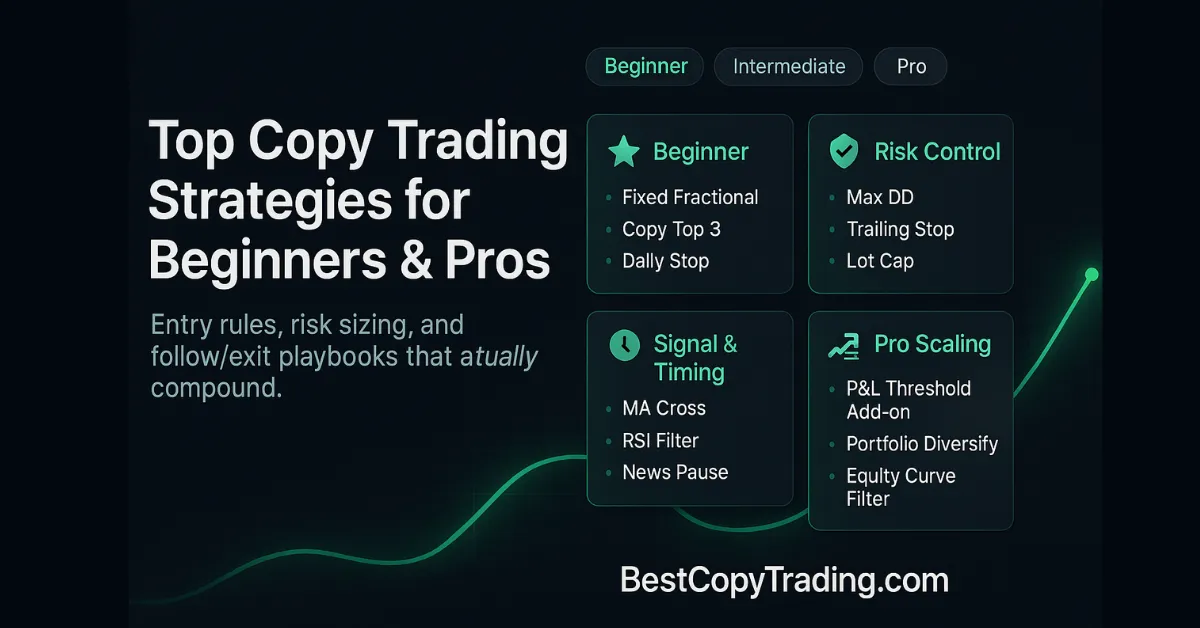
Table of Contents
How Copy Trading Strategies Help You Invest Smarter?
Copy Trading vs. Manual Trading
Unlike manual trading—where you need to analyze charts, follow news, and make decisions on your own—copy trading allows you to automatically mirror the trades of professional investors. It’s a hands-off approach that makes trading accessible, especially for beginners or those without time to manage trades actively.
While manual trading demands deep market knowledge and emotional discipline, copy trading strategies simplify the process while still offering solid profit potential.
How Copy Trading Strategies Operate in Real Time
A copy trading strategy links your trading account to a chosen trader (also called a signal provider). Whenever they open or close a trade, your account automatically replicates that action based on your allocated capital and risk settings.
Modern platforms like eToro, ZuluTrade, or BingX allow users to follow multiple traders, customize investment amounts, set risk controls, and monitor performance metrics—all in real time.
Benefits of Using Automated Copy Trading Strategies
Using an automated copy trading strategy offers several key advantages:
- Time-saving: No need to analyze the market or stay glued to the screen.
- Learn by observing: See how expert traders make decisions and manage risk.
- Diversification: Copy multiple traders across different markets to reduce risk.
- Beginner-friendly: Even without trading experience, you can start investing with low capital.
- Fully automated execution: Trades are copied instantly, eliminating delays or emotional interference.
Key Types of Copy Trading Strategies
Copy trading strategies must be tailored to individual goals. Depending on your experience, risk appetite, and level of involvement, there are several copy trading strategies you can adopt. Here’s a closer look at the core types you can consider.
Manual Copy Trading Strategy
In a manual copy trading strategy, investors actively choose which trades to copy and when. Instead of relying on automation, you monitor a trader’s performance and manually execute trades that align with your goals.
This strategy offers more control but requires time, market awareness, and the ability to make quick decisions. It’s ideal for those who want to follow expert traders while still staying engaged with the trading process.
Auto Copy Trading Strategy
An auto copy trading strategy allows you to mirror another trader’s actions in real time without manual intervention. Once connected, every trade they open, modify, or close is automatically replicated in your account based on your predefined settings.
This strategy is perfect for investors who want hands-free execution while still maintaining oversight. You can set investment limits, adjust risk levels, or pause copying anytime, making it a flexible and efficient way to trade.
Copy Trading on Autopilot: Understanding Full Automation
A fully automated copy trading strategy takes automation a step further. Beyond copying individual traders, it often leverages AI, algorithms, or predefined logic to manage your portfolio entirely on autopilot.
With this approach, the system evaluates performance data, diversifies across multiple providers, and adapts to market conditions—all without manual input. It suits passive investors who want consistent exposure to the market with minimal maintenance.
Social Copy Trading Strategy
Social copy trading blends investment with community insight. Traders share their strategies, trade history, and risk profile openly, and investors can follow, copy, or interact with them through comments and performance tracking.
This strategy thrives on transparency and crowd intelligence. By observing how top-ranked traders operate and exchanging insights with other users, you not only copy trades but also learn and grow as an investor.
Top Copy Trading Strategies for Different Goals
Investors approach copy trading with different goals in mind—some aim for capital protection, others pursue aggressive growth, while many look for a mix of both. The most effective copy trading strategy is the one aligned with your personal risk tolerance, financial timeline, and overall investment objective. Below are four strategic approaches tailored to distinct trader profiles.
Capital Preservation Through Low-Risk Copy Trading
For conservative investors, the priority is to safeguard capital while earning steady returns. This strategy focuses on copying traders with long track records, low drawdowns, and a history of disciplined risk management.
This strategy typically involves the following elements:
- Choosing providers with low volatility trading styles (e.g., swing or position traders)
- Allocating smaller portions of capital to each trader
- Avoiding high-leverage or short-term speculation
This approach won’t deliver overnight gains, but it helps maintain account stability—especially important during turbulent market conditions.
Growth-Driven Copy Trading with Elevated Risk Exposure
If you’re aiming for aggressive growth and can tolerate short-term losses, this strategy focuses on high-performing traders who specialize in volatile markets or use leveraged instruments.
You’ll typically:
- Follow traders with bold, high-frequency strategies (like scalping or crypto futures)
- Accept larger drawdowns in exchange for potentially outsized returns
- Monitor performance more actively to avoid extended losses
While risky, this approach can deliver exceptional results in trending markets. Just remember: this strategy requires both nerves of steel and strong exit discipline.
Diversification Strategy Using Multiple Traders
This strategy aims to balance risk and reward by copying multiple traders across different assets, styles, and regions. It reduces reliance on any single individual’s performance and smooths out fluctuations in your portfolio.
Execution tips:
- Choose a mix of traders: some low-risk, some moderate, some growth-oriented
- Spread investments across markets (forex, stocks, crypto, commodities)
- Regularly review correlation and adjust allocation accordingly
Diversification doesn’t guarantee profits, but it reduces vulnerability to sudden losses and increases the consistency of returns over time.
Copy Trading Strategy for Passive Income Seekers
If your goal is steady, hands-free income, this strategy focuses on copying traders who prioritize monthly or quarterly gains with minimal drawdowns.
How it works:
- Select providers with consistent monthly ROI and low trade frequency
- Set up automated copying with conservative risk settings
- Withdraw profits periodically instead of compounding indefinitely
This strategy is ideal for retirees, busy professionals, or anyone looking to generate side income without constant involvement.
Choosing the Copy Trading Strategy That Fits Your Goals
Selecting the right copy trading strategy requires more than just following top-ranked traders. It involves understanding your own risk profile, financial timeline, and how to evaluate trader data properly. These are the core considerations when choosing your strategy:
Risk Tolerance & Capital Allocation
Your strategy should start with an honest assessment of how much risk you’re comfortable taking. Do you prioritize long-term returns even if it means enduring short-term dips — or would you rather maintain portfolio stability, knowing the growth may be more modest?
Once you’ve identified your risk tolerance, allocate your capital accordingly:
- Low-risk traders: Invest a larger portion of your portfolio
- High-risk traders: Limit exposure to smaller percentages
- Use stop-loss and drawdown settings to manage downside effectively
Don’t overcommit funds you can’t afford to lose. Responsible allocation is key to long-term survival.
Choosing Strategies Based on Duration and Desired Returns
Different strategies align with different timelines. Are you investing for the next six months, or do you plan to grow wealth steadily over several years?
For example:
- Short-term goals: You might copy aggressive traders for faster returns—but with higher risk.
- Long-term goals: Consider stable traders with consistent performance and low volatility.
Clarifying your time horizon helps set realistic expectations and avoid emotional decision-making when markets fluctuate.
Performance Indicators That Matter in Copy Trading
Blindly copying traders based on ROI alone is risky. Instead, look at a combination of performance indicators:
- Win rate vs. risk-reward ratio
- Average trade duration
- Maximum drawdown
- A stable performance history spanning 6 to 12 months
- Number of followers vs. capital under management
Dig deeper into a trader’s history—not just their headline stats. A solid copy trading strategy is built on data-driven decisions, not hype.
Best Platforms for Auto Copy Trading in 2026
The success of any copy trading strategy depends not only on who you copy, but also on where you copy them. Platforms differ in how they support automation, risk control, transparency, and user control—factors that directly impact your strategic outcome.
Here are the top platforms for implementing different types of auto copy trading strategies in 2026:
eToro – Best for Balanced Strategies and Beginner Growth
If you’re looking to build a diversified or low-risk strategy, eToro offers a rich pool of verified traders with historical data, risk scores, and investor sentiment tools. Its “CopyPortfolios” are ideal for hands-free, diversified exposure.
👉 See our full guide to eToro copy trading »
ZuluTrade – Ideal for Manual + Auto Strategy Combinations
ZuluTrade bridges the gap between manual and auto copy trading strategies by offering rich customization. You can choose traders based on detailed metrics, set your own stop-loss rules, or even create a blended portfolio of strategies.
👉 Explore ZuluTrade strategy insights »
BingX – Tailored for High-Risk, High-Return Crypto Strategies
For traders with a high-risk appetite, especially in the crypto space, BingX is a solid choice. Its transparent trader rankings and flexible margin settings allow you to execute aggressive short-term strategies while still managing risk.
👉 Read our in-depth BingX review »
MEXC – Designed for Diversified Crypto Copy Trading
If your strategy involves copying multiple crypto traders across altcoins and futures, MEXC delivers both depth and diversity. It’s well-suited for automated and diversification-focused strategies in the digital asset market.
👉 Discover MEXC strategy potential »
OctaFX – Best for Simple Passive Income Strategies
OctaFX is optimized for those who want a set-and-forget copy trading setup. If your goal is passive income through copying low-frequency, consistent traders, OctaFX’s mobile-native design and simplicity make it highly accessible.
👉 Learn how to use OctaFX for passive strategies »
AvaTrade – Great for Multi-Asset Strategy Execution
With support for DupliTrade and ZuluTrade integrations, AvaTrade enables more advanced users to combine multi-asset strategies across forex, stocks, and indices. Ideal for strategic traders who diversify beyond crypto.
👉 Check our AvaTrade copy trading breakdown »
✅ Pro Tip: Your platform should match your strategy. For example, a long-term capital preservation strategy may work better on eToro, while short-term crypto momentum strategies thrive on BingX or MEXC.
Tips to Optimize Your Copy Trading Strategy
Even the best copy trading strategies can underperform if not executed with discipline. Whether you’re building a conservative portfolio or chasing higher returns, fine-tuning your approach makes a major difference. Here are four proven tips to optimize your results:
Set a Stop-Loss
Never copy trades blindly without a safety net. A stop-loss acts as your last line of defense, helping you cap potential losses when a trader enters a losing streak.
Best practices:
- Set a maximum drawdown limit per trader
- Use capital protection tools offered by your platform
- Review stop-loss settings monthly based on market volatility
The goal isn’t to prevent losses altogether, but to control them intelligently.
Stay Updated on Trader Behavior and Performance
Even the most consistent traders can hit rough patches—or change their strategies without notice. Regularly checking performance ensures your copy trading strategy stays aligned with your goals.
Things to watch:
- Is the trader’s win rate or risk profile shifting?
- Are they trading more frequently or changing asset classes?
- Has their drawdown increased significantly?
Copy trading is not a “set-and-forget” system. A quick 10-minute review each week can help you avoid major setbacks.
Avoid Over-Reliance on Past Returns
High historical returns are tempting, but they don’t guarantee future results. In fact, many top-performing traders from one quarter underperform the next.
What to focus on instead:
- Risk-adjusted performance (e.g., Sharpe ratio, drawdown)
- Strategy consistency over time (3–6 months minimum)
- Behavior during volatile periods (do they panic or stay calm?)
A sustainable copy trading strategy values stability over hype.
Begin with Minimal Capital, Then Scale Up Strategically
One of the biggest mistakes beginners make is going “all in” from day one. Instead, test your strategy with small amounts, track the outcome, and scale only when you’re confident in both the trader and the platform.
Suggested approach:
- Begin with 10–20% of your planned capital
- Monitor results over 4–8 weeks
- Gradually increase allocation or diversify across more traders
Scaling with data, not emotion, is what separates smart investors from lucky ones.
Common Mistakes in Copy Trading Strategies
While copy trading simplifies investing, it still requires strategic thinking. Many beginners (and even some seasoned users) fall into the trap of treating it as a shortcut to fast profits. Below are the most common pitfalls that can undermine your copy trading strategy—and how to avoid them.
Blindly Copying Top Performers
A trader with the highest return doesn’t always make the best choice. Many top performers rely on high-risk, short-term tactics that may not align with your goals.
Why this is risky:
- Their success may be based on luck or unsustainable strategies
- A single bad trade could wipe out recent gains
- Their risk appetite may be far above yours
Instead: Look beyond the leaderboard. Study consistency, risk management, and trading style before clicking “Copy.”
Ignoring Risk Levels
One of the core components of a solid copy trading strategy is matching risk levels with your financial profile. Many users ignore this, chasing performance without understanding the volatility behind it.
Common warning signs:
- High leverage with minimal stop-loss protection
- Sudden swings in account balance
- Traders with large position sizes relative to capital
Tip: Always evaluate a trader’s drawdown history, trade size, and risk score—not just their profit percentage.
Not Diversifying Across Traders
Putting all your funds behind a single trader—even a strong one—is never wise. Market conditions change, and even the best traders can underperform.
Why diversification matters:
- Reduces exposure to one strategy or market
- Balances performance over time
- Reduces downside exposure during turbulent market conditions
Best practice: Spread your investment across 3–5 traders with different styles, timeframes, and asset classes.
🧠 Copy trading doesn’t mean giving up control—it means making smart choices with the help of other people’s expertise.
FAQs About Copy Trading Strategies
A copy trading strategy refers to a method where you replicate the trades of experienced investors, either manually or automatically. It’s ideal for those who want exposure to financial markets without actively managing positions. Strategies range from low-risk capital preservation to high-growth speculation.
The best copy trading strategy depends on your goals and risk appetite. Identify what you want—growth, stability, or passive income—then evaluate traders based on drawdown, win rate, and long-term consistency. Tools on platforms like eToro or ZuluTrade can help refine your search.
Manual strategies require you to review traders and execute trades yourself. In contrast, an automated copy trading strategy runs in real time and copies positions instantly based on your allocation, ideal for passive investors.
Absolutely. A crypto copy trading strategy focuses on replicating traders who specialize in cryptocurrencies. Platforms like BingX and MEXC offer automated crypto-focused copy trading, with tools to manage risk and leverage.
Yes, but it depends on how well you manage risk. Avoid chasing flashy returns. Instead, diversify your copy trading strategies and focus on traders with proven track records and strong risk control metrics.
Copy trading strategy settings vary by platform and goal. Generally, set low allocation per trader (10–20%), activate stop-loss protections, and avoid high leverage. Some platforms offer beginner-friendly presets you can start with.
eToro is a great choice for a copy paste trading strategy. You can mirror a trader’s full portfolio with a single click, including their assets, positions, and allocation ratios.
Yes. An eToro copy trading strategy is beginner-friendly thanks to its transparent stats, risk scores, and easy-to-use dashboard. It also lets you pause copying anytime and add stop-loss rules for control.
In bullish conditions, the best auto copy trading strategy is usually one that follows breakout or momentum traders. Focus on traders with consistent wins during uptrends and reasonable drawdowns.
Most platforms don’t integrate directly with TradingView strategies, but some traders use TradingView for signals and execute their setups manually or via API-connected platforms. It’s a more advanced approach but doable.
Final Thoughts
Copy trading strategies offer a powerful way to access financial markets without needing technical expertise. Whether you’re building wealth slowly or aiming for higher returns, the right approach can turn passive investing into a sustainable part of your financial plan.
The key?
Choose wisely, monitor actively, and scale strategically.
Let your strategy—not emotions—guide your decisions.
Want copy trading strategies that actually compound?
Join our Telegram for daily setups, risk templates, and pro-grade playbooks: https://t.me/bestcopytradingcom


