

FundingPips Copy Trading requires a compliance-first setup: third-party copiers aren’t allowed, so go manual-first with risk/trade-manager EAs for sizing and journaling. This BestCopyTrading.com guide shows per-symbol and total-risk caps, plus low-frequency strategy archetypes that minimize slippage and pattern-detection flags.

Table of Contents
Is Copy Trading Allowed at FundingPips — and Under What Conditions?
Quick summary: Third-party vendor copiers are not allowed under FundingPips Copy Trading rules. The safest, compliance-first path is manual replication, while risk/trade-manager EAs are generally acceptable only if they don’t auto-execute trades for you.
What this means for traders: Go manual-first, and keep audit-ready logs (timestamped screenshots, order journal, entry/exit, size/SL/TP) to protect payouts and resolve disputes.

What “Counts as Copying” at FP?
- Manual following vs. auto-execution: Manual following means you decide entries and manage orders yourself (and leave a verifiable trail). Auto-execution tools that place trades on your behalf increase compliance risk and can be flagged as prohibited copying.
- Pattern detection: Perfect clones across accounts—identical timestamps, lots, and entry points—raise red flags. Introduce reasonable variance and avoid synchronized bursts that look like automation.
FundingPips vs Other Prop Firms — What’s Stricter, What’s Safer?
To benchmark risk, compare policy language (not promises) across firms. This helps you gauge how conservative your setup should be without claiming any firm is “more open.”
- For a nuanced breakdown of copier wording and restrictions, see FTMO copy trading rules (nuance & restrictions).
- For historical lessons that support a manual-first approach, review MFF policy snapshots (archived).
Link: /myforexfunds-copy-trading/ - For edge cases around what “internal copy” can mean in practice, read FundedNext policy corner cases (compliance context).
FundingPips Account Types & Their Copy-Trading Rules
Purpose: Understand how each model (Evaluation vs. Zero/Instant vs. Pro) affects FundingPips Copy Trading compliance so you can set up safely without breaching rules.
Models Overview: Evaluation vs. Zero (Instant-Style) vs. Pro
Why it matters for copiers: Your account model dictates the risk guardrails, any minimum profitable-days requirements, and how strictly you must control lot size/exposure. While the trading logic may stay the same, compliance tolerance and review scrutiny can differ by model—so plan your execution and logging accordingly.
FundingPips Copy Trading: Risk Limits You Must Meet
- Daily/Max loss (model/phase specific): These are the primary levers FP uses to police behavior. Breaches can void payouts regardless of profitability.
- Per-trade discipline: Avoid over-exposure on a single symbol. Prefer %-of-equity sizing over fixed lots so that risk scales consistently.
- Lot/exposure caps (where applicable): Set per-symbol caps to prevent correlated blow-ups when following external signals manually.
Is Copying Treated Differently by Model?
- Evaluation accounts: Emphasis on consistency and risk control. Third-party vendor copiers remain prohibited; if you mirror signals, do it manually and maintain audit-ready logs.
- Zero/Instant-style accounts: The underlying prohibition on vendor copiers doesn’t change. Preferred pathway is manual replication supported by risk/trade-manager EAs (non-auto-execution) and thorough journaling.
- Pro accounts (where offered): Same compliance baseline—manual-first, documented variance, and strict adherence to model-specific loss limits.
Quick Policy Matrix (Editorial Summary)
| Model | Daily/Max Loss (frame) | Exposure Discipline | Copier (third-party vendor) | EA (risk/trade manager) | Notes on Audit Logs |
|---|---|---|---|---|---|
| Evaluation | Model/phase specific | Per-symbol caps; %-equity sizing | Not allowed | Allowed if non-auto-execution | Keep screenshots, timestamps, order journal |
| Zero / Instant | Model specific | Same as above | Not allowed | Allowed if non-auto-execution | Prove manual decisions; record variance |
| Pro | Model specific | Same as above | Not allowed | Allowed if non-auto-execution | Retain full trail for payouts |
Editor’s note: Always re-check the latest Terms & Conditions / Terms of Use before applying any setup. If in doubt, obtain written clarification from support.
Execution Helpers (Non-Copy) & Setup Notes
To stay compliant with FundingPips Copy Trading rules, replace “trade copier” talk with execution helpers that don’t auto-execute external signals. These tools streamline risk, discipline, and record-keeping—without violating vendor-copier prohibitions.
Risk/Trade-Manager EA — What’s Typically Allowed
What these EAs can do (non-copy):
- %-of-equity sizing to keep per-trade risk consistent as balance changes
- Auto-SL/TP placement, trailing, and time-window blockers
- News filters that pause trading around scheduled events
- Session controls (e.g., no new orders in low-liquidity hours)
Best practices:
- Enable journaling and export activity logs (orders, edits, timestamps)
- Keep a change log for settings/versions; annotate exceptions and manual overrides
- Verify that no module performs auto-execution based on third-party signals
MT4/MT5 Setup & Broker Considerations
When you follow external ideas but execute on FP accounts, expect different liquidity and routing vs the source environment:
- Run a separate demo to measure slippage, fill rate, and spread drift on your instrument list
- Map symbol names/contract specs (digits, tick size, min lot, step) to prevent rejected orders
- Standardize execution latency: VPS close to the FP trade servers can stabilize fills without “edge-gaming”
Latency & Execution Accuracy (Manual-First)
Aim for a 100–300 ms “see-and-click” window that’s stable rather than aggressively optimized:
- Prioritize consistency over ultra-low latency to avoid patterns associated with latency-arbitrage
- Use checklists: confirm symbol, size (%-equity), SL/TP distance, and per-symbol cap before sending
- Log the human decision moment (screenshot + timestamp) to prove manual intent
Internal Link (Tools Cluster, Compliance Notice)
For a vetted roundup of non-copy utilities—risk managers, journals, and latency monitors—see best trade copier software (read before using at FP); review the compliance notes first, as third-party vendor copiers are prohibited for FundingPips Copy Trading.
How to Set Up Copy-Style Trading at FundingPips Without Violations
“Copy-style” here means following external signals without any third-party vendor copier. The safest path for FundingPips Copy Trading is a manual-first workflow supported by risk/trade-manager EAs (non-auto-execution), strict journaling, and clear risk caps.
Manual Copying Techniques (Compliance-First)
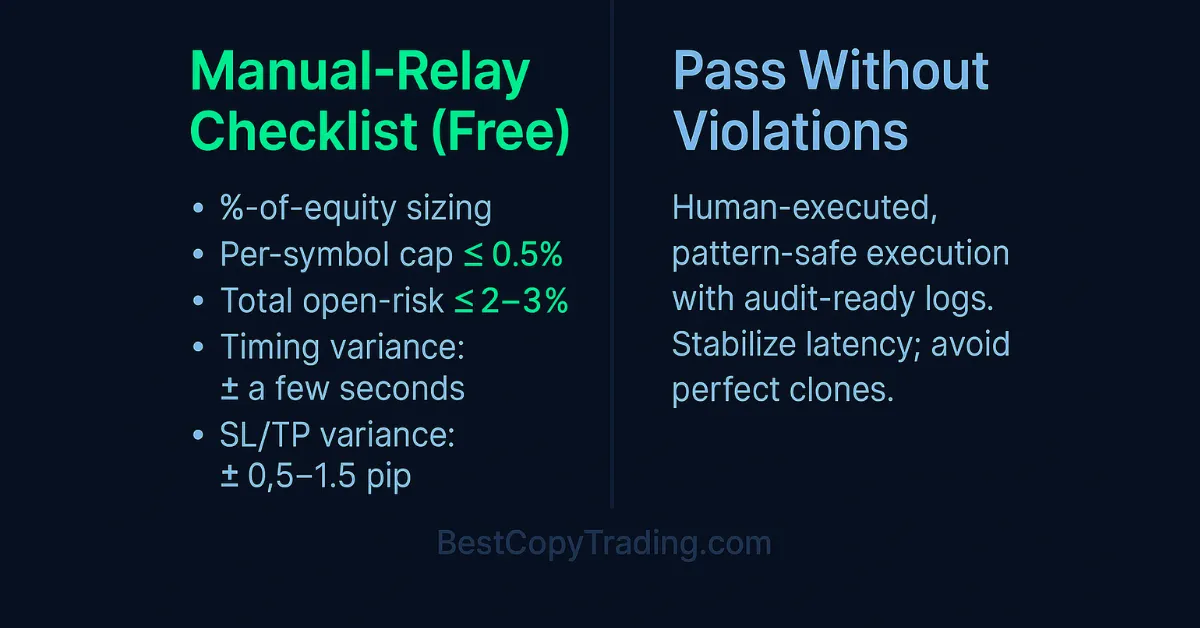
Checklist (put this into your routine):
- %-of-equity sizing for consistent per-trade risk
- Per-symbol cap ≤ 0.5% (editorial baseline)
- Total open risk ≤ 2–3% (editorial baseline)
- Reasonable delay window (aim for stability, not latency-arb)
- Audit-ready proofs: screenshots with timestamps, order journal (entry/exit, size/SL/TP), and brief notes on decision context
Anchor: manual copy trading workflow (audit-ready) — practical steps for a compliant manual-first setup.
Signal Following Without Third-Party Auto-Copier
Whether signals come from Telegram, Discord, or Email, keep execution human-decided:
- Read → confirm instrument & size caps → place order manually
- Add small, sensible variance (timing, SL/TP) to avoid “perfect clones”
- Log the decision moment to evidence manual intent
Anchor: Telegram copy trading guide (manual-relay only at FP) — how to structure Telegram workflows without auto-execution.
Risk Control When Mirroring External Signals
To reduce compliance flags and payout disputes:
- No piling multiple tickets on the same symbol; respect per-symbol and total-risk caps
- Avoid perfect clones across accounts (identical timestamps/lot maps)
- Control trading sessions (liquidity windows) and news proximity to limit slippage
Anchor: copy trading risk management (caps & guardrails) — the risk template to keep FundingPips Copy Trading inside limits.
Copy-Friendly Strategy Archetypes That Fit FP Rules
Low-Frequency Swing Following
Lower trade frequency reduces slippage and makes FundingPips Copy Trading risk caps easier to enforce. Favor clean daily/4H structures, clear invalidation levels, and wider stops sized by %-of-equity. This helps you stay within daily loss and per-symbol exposure while avoiding timestamp clustering that looks automated.
AI/EA-Generated Signals (Human-Executed)
Use AI/EA only to generate ideas—you execute the orders manually. Keep small, sensible variance (entry timing, SL/TP offsets) and log the human decision moment for audit-readiness.
Anchor: AI copy trading signals (human-execute at FP) — how to leverage AI outputs without breaching copier rules.
Multi-Account Mirroring from a Master (Same Owner)
If you operate multiple accounts, mirror ideas manually per account—no third-party vendor copiers. Stagger entries modestly, respect per-symbol caps, and document rationale per account. When in doubt, seek written confirmation from support before attempting any synchronized workflow that could be misread as automated copying.
Real-World Feedback & Community Notes
What Traders Report (Reddit/Discord)
Common themes include pattern detection, over-copy, identical timestamps, and suspected latency-arbitrage. For FundingPips Copy Trading, traders emphasize manual-first execution, small timing/SL-TP variance, and thorough journaling to avoid flags and payout disputes.
Anchor: copy-trading Reddit discussions (policy & risk themes) — curated threads on compliance pain points and practical fixes.
Anchor: Discord copy-trading rooms (manual-relay best practices) — workflows for manual relays, logging routines, and risk caps that pass reviews.
Pass Stories Using Signal Following (Manual)
Mini case notes from the community point to three recurring success factors:
- Lower frequency to curb slippage and timestamp clustering
- Liquidity windows (session overlaps) for more reliable fills
- Small, sensible variance on entries/SL/TP to avoid “perfect clones” across accounts
These patterns align well with a compliance-first approach to FundingPips Copy Trading: manual decisions, per-symbol caps, and audit-ready logs.
FundingPips vs Alternatives for Copy-Style Setups
FundedNext vs FundingPips — Which Is More Flexible?
If you lean toward copy-style workflows but want to avoid vendor copiers, compare policy tone and enforcement examples first. For context, see FundedNext copy trading overview (compare policy tone) to understand how their wording is framed for manual followers versus automation.
FTMO and MFF Compared — Policy Language Contrast
Before committing to any stack for FundingPips Copy Trading, benchmark how other firms phrase copier restrictions and review guardrails:
- FTMO copy trading guide (nuance & guardrails) — highlights of what’s explicitly allowed and what’s scrutinized.
- MFF status hub (archived; manual-first lessons) — historical takeaways that reinforce a manual-first, audit-ready approach.
When to Choose FundingPips Over Others
Choose FundingPips if you:
- Prefer a manual-first execution style and can maintain audit-ready logs
- Are comfortable with %-of-equity sizing, per-symbol caps, and total-risk limits
- Trade swing/position structures (lower frequency, cleaner invalidation) rather than ultra-fast scalping
This stance pairs well with the compliance-first workflow outlined in this guide and keeps your FundingPips Copy Trading setup within clearly documented boundaries.
FAQs About FundingPips Copy Trading
Vendor copiers: not allowed. Risk-/trade-manager EAs: generally acceptable if they do not auto-execute trades for you. Keep manual control and maintain audit-ready logs.
Following signals is fine when you place orders manually. Third-party auto-execution bots are prohibited. Aim for small, sensible variance (timing/SL/TP) and document your human decision point.
Pattern detection is possible. Perfect clones (identical timestamps, lot maps, and entries across accounts) can be flagged. Use modest variance and keep transparent logs to evidence manual intent.
Use a manual-first workflow with %-of-equity sizing, per-symbol caps, and total open-risk limits. Add small variance to SL/TP/timing, avoid stacking tickets on one symbol, and keep a complete journal (screenshots, timestamps, order notes).
Editorial Warning: Pattern & Over-Copy Risks
Perfect clones (100% synchronized from a master) can be flagged by pattern detection: identical timestamps, lot maps, mirrored opposite-accounts, and signs of latency arbitrage.
- Add variance: entry time ± a few seconds; SL/TP offsets ± 0.5–1.5 pip (FX).
- Enforce per-symbol caps and total open-risk limits at all times.
- Keep audit-ready logs: screenshots, timestamps, order notes, and rationale.
- Avoid stacking multiple tickets on the same symbol in rapid succession.
Get latency-aware checklists & real-time reminders in our Telegram: BestCopyTrading.com


