

AI Copy Trading Signals are model-generated alerts designed for speed, consistency, and hands-free execution. At BestCopyTrading, we break down how ai copy trading signals are built from data, why ai trading signals can outperform manual calls in fast markets, and how to wire automated trading signals into your account with safe guardrails. Whether you trade FX or digital assets, this guide covers ai forex signals and ai crypto signals end-to-end—from data inputs and modeling to routing, copier setup, latency control, and post-trade audits—so you can evaluate providers, reduce false positives, and automate execution with confidence.

AI Copy Trading Signals: What Are They?
AI copy trading signals are model-generated trading alerts designed to be copy-ready: they specify direction, entry, exit (SL/TP), and a confidence score so you can route them straight into execution—without rewriting rules or guessing context. Unlike general “AI copy trading” (which focuses on platforms or bots), this page is about the signal itself—how it’s created, delivered, filtered, and executed.
Working Definition
AI copy trading signals are structured alerts produced by algorithms (ML/DL/stat-arb) that translate data into trade instructions you can automate.
- What’s inside a signal: instrument, side (long/short), entry type (limit/market), price levels, SL/TP, confidence/probability, validity window, optional tags (trend, news-risk, regime).
- Delivery channels: API, webhook, Telegram, email (JSON or formatted text).
- Execution path: Signal → (Filters/Throttle) → Copier → Broker/Exchange (MT4/MT5, Bybit, OKX, etc.) → Post-trade audit (fills, slippage, PnL).
- Scope vs basics: If you need foundational concepts of copy trading first, see our copy trading basics.
Minimal example (for clarity):
symbol: BTCUSDT
side: long
entry: limit @ 63,250
stop_loss: 62,480
take_profit: 64,400
confidence: 0.72
valid_for: 15m
tags: [“trend_continuation”,”medium_vol”]
AI Signals vs Manual/Human Signals
Both aim to provide trade ideas you can copy, but they differ in how they’re produced and executed.
- Latency & consistency: AI signals are machine-timed and consistent (no fatigue), helping with faster, repeatable decisioning; humans can be delayed or inconsistent under stress.
- Emotional bias: Models are emotionless; human signals may suffer from fear/greed, chasing, or reluctance to cut losses.
- Coverage & scale: AI can scan more markets/timeframes in parallel; human analysts specialize but cover less.
- Context & regime shifts: Humans may react better to unusual context (policy shocks, one-off events). Good AI setups mitigate this with news pauses and regime filters.
For a deeper look at discretionary workflows, see manual copy trading.
AI Signals vs AI Bots
They’re related but not the same—and mixing them up causes tool choice errors.
- AI Signals: Alerts + execution pipeline. A signal fires, you (or your copier) execute, then it’s done. State is minimal outside of logs/metrics.
- AI Bots: Autonomous strategies with state. Bots hold internal state (indicators, trailing logic, pyramiding rules) and continuously manage positions without a separate “alert → execute” handoff.
- Operational difference:
- Signals work best with webhook/API → copier flows, strong filters, and latency budgets.
- Bots require ongoing monitoring of strategy state, parameters, and error handling.
For an in-depth comparison to avoid overlap in tooling, see AI signals vs bots.
How AI-Based Signals Work (Lifecycle & Execution Path)
AI signals follow a repeatable pipeline: Data → Features → Model → Signal Scoring → Filters/Throttling → Routing → Execution → Audit → Learning. Focusing on this lifecycle keeps the page signal-centric (not platform-centric) and supports search intent around data-driven trading signals.
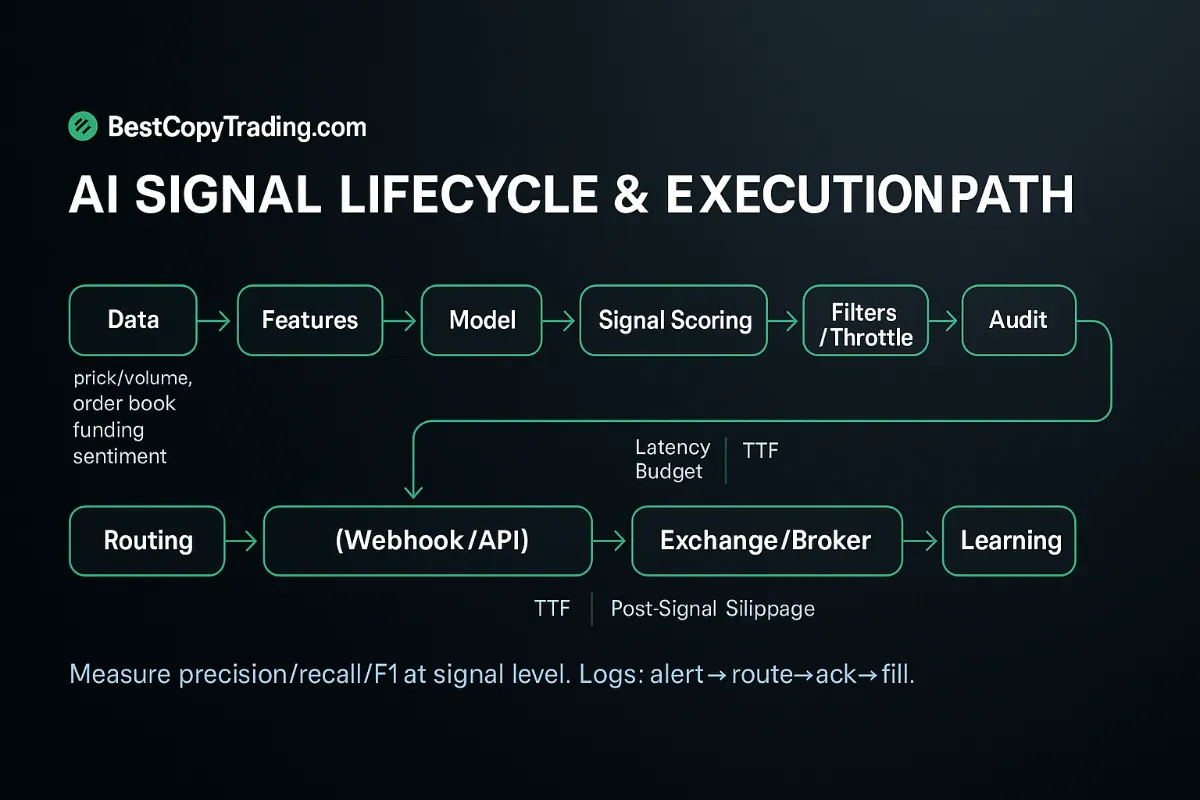
Input Data & Feature Engineering for AI Signals
AI copy trading signals start with diverse, high-frequency data and carefully engineered features.
- Market data: price, volume, volatility (ATR, RV), spreads; order book depth/imbalance, resting liquidity, sweep events.
- Derivatives/funding: funding rates, basis, open interest, put-call ratios, perpetual vs dated futures skew.
- Flow & microstructure: trade prints, aggressor side, tick rules, inventory pressure.
- Sentiment/news (optional): headlines, social/Reddit/Twitter embeddings, calendar events (CPI, FOMC), topic scores.
- Feature engineering: returns (Δ1m/Δ5m), z-scores, regime flags (trend/chop), realized/expected vol, order-book imbalance, news risk flags, time-of-day seasonality.
Goal: convert raw feeds into stable, predictive features while minimizing leakage and overfitting.
Models & Scoring
Models translate features into actionable predictions at the signal level.
- Model families: tree ensembles, gradient boosting, LSTM/Transformer for sequences, anomaly/outlier detectors, regime classifiers to switch logic across market conditions.
- Outputs: probability of move (e.g., P(up ≥ X bps in Y min)), directional confidence, expected reward/risk, suggested SL/TP.
- Per-signal metrics (not platform KPIs):
- Precision/Recall/F1 at the alert granularity (did the predicted move materialize within validity?).
- Calibration: does 0.70 confidence ≈ 70% realized hit rate?
- Regime performance: F1 by trend/chop/high-vol buckets; lift vs naive baseline.
Keep evaluation out-of-sample (and, ideally, walk-forward) to mirror live deployment.
Throttling, Filters, and Routing
Before an alert reaches your account, guardrails improve quality and stability.
- Filters:
- Volatility guard: block signals when realized vol > cap or during extreme spreads.
- News pause: auto-hold around scheduled macro/news windows.
- Time-of-day: avoid illiquid shifts; exchange maintenance windows.
- Cost caps: spread ≤ N ticks; slippage caps vs reference price.
- Position constraints: max concurrent signals, symbol quotas, correlation limits.
- Throttling: rate-limit alerts, enforce cool-downs per instrument/strategy.
- Routing: Webhook/API → Copier → Exchange/MT4/MT5 with payloads carrying instrument, side, entry, SL/TP, confidence, validity, and tags.
- Automation stack: natural anchor automation tools
Result: fewer false positives during chaos, cleaner fills, and predictable execution behavior.
Real-Time Execution & Latency Budget
Execution transforms a “good idea” into PnL; latency control is pivotal.
- Key timings:
- Time-to-signal (TTS): data → model → alert.
- Time-to-fill (TTF): alert → broker/exchange fill (impacted by queue position, order type).
- Post-signal slippage: (fill_price − reference_price_at_alert) / reference_price.
- Tactics to reduce slippage: co-location (where possible), pre-approved IPs, lean FIX/REST paths, limit-with-protection orders, partial fills with cancel/replace rules, and dynamic price offsets.
- Copier quality matters: retry logic, idempotent order keys, circuit breakers, and per-symbol throttles.
- Tooling: natural anchor best trade copier software
Define a latency budget (e.g., ≤120 ms model, ≤250 ms transport, ≤500 ms to first fill) and monitor breaches.
Post-Trade Audit & Feedback Loop
Close the loop to keep signals adaptive and accountable.
- Execution logs: timestamps for alert, route, ack, fill; venue, order type, size, cancel/replace rate, reject reasons.
- Quality analytics: realized vs expected move, per-signal P&L attribution, slippage histograms, time-in-market, MFE/MAE after entry.
- Drift & health checks: feature drift, hit-rate decay, latency spikes, symbol-specific anomalies.
- Adaptive learning: reweight by regime, decay stale patterns, update filters (e.g., stricter spread caps during chop), periodic walk-forward re-training.
Treat the audit as a first-class product: what isn’t measured won’t improve.
Best AI Signal Tools & Platforms (2026)
This section focuses only on signal providers/apps (crypto & forex). We avoid bots or general copy-trading platforms to keep scope clean and prevent overlap with other pages. For the living shortlist and deeper reviews, see our AI trading tools list at BestCopyTrading.
AI Crypto Signal Platforms
Positioning. AI crypto signal platforms specialize in high-frequency market reads (spot & perps) and fast delivery paths (API/webhook/Telegram) that plug into trade copiers for hands-free execution.
Selection criteria (use as a due-diligence checklist):
- Markets covered: BTC majors, alt L1/L2, perps vs dated futures, liquidity tiers (A/B).
- Connectors: native APIs, webhooks, JSON payloads; exchange coverage (Bybit/OKX/Binance/Kraken) and auth model (keys, scopes, IP whitelist).
- Latency & stability: median alert-to-webhook time, p95/p99 spikes, retry/idempotency, rate-limit handling.
- Signal quality artifacts: confidence scores, regime tags, validity windows, cancel/replace logic.
- Backtesting & walk-forward: per-signal precision/recall/F1, regime-split results (trend/chop/high-vol), out-of-sample disclosures.
- Execution logs: time-stamped alert/route/ack/fill, slippage vs reference, error taxonomy.
- Risk controls: spread/slippage caps, max concurrent signals, symbol quotas, news pause, kill-switch.
- Pricing & limits: tiers by volume/webhook rate, seats, SLA, audit log retention.
Tip: Favor vendors that publish post-signal slippage distributions and provide exportable per-signal logs (CSV/JSON) for your own audit.
AI Forex Signal Apps
Positioning. FX-focused apps emphasize MT4/MT5 compatibility and copier stability across brokers with different execution models (ECN/STP/market maker).
Selection criteria (FX-specific):
- MT4/MT5 integration: trade copier bridge, magic numbers/tickets, partial closes, trailing/BE rules.
- Broker execution: supported brokers, slippage/requote handling, GMT/offset management, trading sessions.
- Signal structure: pair, side, entry type, SL/TP, confidence, time-in-force; hedging vs netting support.
- Drawdown after signal: post-signal MDD per pair/timeframe, MAE/MFE curves, time-to-fill metrics.
- Filters: spread & session filters (Asian/NY overlap), news calendar pause, max open signals per pair.
- Risk alignment: lot sizing modes (fixed/percent/balance), per-signal caps, portfolio correlation checks.
- Reporting: broker-level fills, copier error logs, reject reasons, reconciliation with account history.
- Pricing: monthly vs performance-based, copier seat limits, SLA and support hours.
Tip: Insist on pair-level drawdown profiles and forward test results—backtests alone often overstate FX signal quality.

Comparison Table: Traditional vs AI Signal Tools
Use this table to set expectations and guide tool choice. (“Traditional” = manual channels like Telegram/email groups; “AI Signal Tool” = structured, machine-generated signals with automation hooks.)
Traditional vs AI Signal Tools — Comparison
| Tool Class | Markets | Delivery (API/Webhook/Telegram) | Connectors (MT4/MT5, Bybit, OKX, Binance) | Latency | Backtest | Logs | Pricing |
|---|---|---|---|---|---|---|---|
| Traditional Signal Channel | Limited by analyst coverage; fewer exotic pairs | Telegram/Email only; manual copy/paste | Usually none; manual order entry | Human-scale (seconds–minutes); inconsistent | Rarely disclosed; not reproducible | Minimal; screenshots/posts | Flat monthly or lifetime; little infra cost |
| AI Signal Tool (Signal-Only) | Broad (majors + long-tail) with liquidity filters | Webhook/API (JSON), plus Telegram for visibility | Native: MT4/MT5 bridges; exchange APIs (Bybit/OKX/Binance) | Low & measurable; p95/p99 tracked | Per-signal precision/recall/F1; walk-forward | Full audit: alert→route→ack→fill; slippage | Tiered (webhook rate, seats, SLA); log retention options |
Editor’s note: List 5–8 representative tools (split crypto/forex) on the dedicated hub to keep this page signal-centric and avoid duplication with the general platforms list. For the full, frequently updated catalog, go to AI trading tools list.
Advantages of Using AI Signals
AI signals shine where speed, discipline, and measurable quality matter. The benefits below are tied to signal-level metrics (not generic platform KPIs), so you can track real impact on execution and PnL.
Faster, Real-Time Execution
Why it matters: Markets often move in bursts; taking the first fill at a fair price is half the battle.
- Lower time-to-fill (TTF): Structured alerts (JSON via webhook/API) hit your copier instantly, cutting human delays. Track median TTF and p95 to quantify improvement.
- Fewer missed moves: Pre-defined order templates (limit-with-protection, IOC/PO) reduce “watch and hesitate” gaps.
- Lower post-signal slippage: Monitor (fill − reference_at_alert) / reference_at_alert to prove your instant AI signals actually translate to better entries.
Target: stable latency budget (e.g., ≤250–500 ms to first fill on majors), with p95 slippage under your spread/volatility caps during normal regimes.
Less Emotion, More Consistency
Why it matters: Emotional drift causes late exits, oversized entries, and inconsistent risk.
- Rule stability: Models fire or don’t—no fear/greed. You can enforce confidence-weighted entries (e.g., size scales with calibrated probability or expected R:R).
- Pre-trade constraints: Max concurrent signals, per-symbol quotas, correlation limits—applied the same way every time.
- Post-trade discipline: Auto SL/TP/trailing rules remove second-guessing and keep stats clean for review.
Benchmark consistency via variance of position size vs plan, % of fills with SL/TP attached at creation, and deviation from target risk per trade.
KW: emotionless trading.
Backtesting & Adaptive Learning
Why it matters: Signal quality is not static; regimes shift.
- Backtest the signal, not just the strategy: Evaluate precision/recall/F1 at the alert level within a validity window (e.g., did price travel +X bps in Y minutes?).
- Walk-forward validation: Roll windows forward (train → validate → deploy) to reduce leakage and curve-fit illusions.
- Regime-aware models: Route signals only when regime tags (trend/chop/high-vol) match historical strength, and damp/disable when performance decays.
- Continuous calibration: Align a 0.70 confidence score with ~70% realized hit-rate (Brier, reliability curves).
Track lift over naive baselines and decay rates by month to decide when to retrain or tighten filters.
KW: backtest ai signals.
Examples in Action (Crypto & Forex)
Scenario 1 — Trend continuation (Crypto, BTCUSDT perps):
- Signal: Long, limit @ 63,250; SL 62,480; TP 64,400; confidence 0.72; valid 15 m; tags: trend_continuation, medium_vol.
- Execution: Webhook → copier posts limit-with-protection; fill in 380 ms; post-signal slippage +3.5 bps.
- Outcome: TP hit in 12 m; signal-level F1 improves during trend regime; TTF p95 under 600 ms on Bybit/OKX peers.
Scenario 2 — Mean reversion (Forex, EURUSD):
- Signal: Short, limit @ 1.0886; SL 1.0898; TP 1.0868; confidence 0.61; valid 20 m; tags: mean_reversion, low_vol.
- Execution: MT4 bridge; spread & session filters pass (NY overlap); partial fill then cancel/replace to midpoint; final slippage −1.8 bps.
- Outcome: TP reached in 18 m; MAE shallow; post-signal MDD within pair-level cap; copier logs reconcile with broker fills.
Want a full walk-through of signal → copier → exchange with real logs and fill analysis? See our case study on Bybit (/blog/copy-trading-case-study-bybit/).
Limitations & Risks of AI Signals
AI signals can be powerful, but the risk surface shifts to what happens after an alert fires—interpretability, data quality, infra stability, and execution discipline. Treat the following as mandatory checks before scaling.
Black Box & Transparency Gaps
Modern ML/DL models often trade accuracy for opacity—creating ai trading risk that’s hard to diagnose.
- Limited interpretability: You may know the output (long/short, SL/TP, confidence) but not the why. This impedes post-mortems and parameter tuning.
- Overfitting risk: Models can memorize regimes; performance collapses when conditions change (policy shocks, liquidity drains).
- Poor calibration: A “0.75 confidence” score that realizes 55–60% hit-rate will mis-size positions.
- Model drift: Feature distributions shift (volatility, spreads), silently degrading precision/recall over weeks.
Mitigations: require confidence calibration curves, out-of-sample & walk-forward reports, and per-signal audit logs. Favor vendors exposing feature/attribution snippets or regime tags to aid triage.
Data Bias & False Positives
Garbage in, garbage out—ai false signals often trace back to input quality or unmodeled market states.
- News shocks & macro windows: CPI/FOMC/NFP or crypto headline spikes break short-horizon patterns, spiking false alerts.
- Illiquid hours: Wider spreads and shallow books on off-hours distort features (order-book imbalance, microprice).
- Selection bias: Training on “clean” history without slippage/fees yields unrealistic precision.
- Survivorship & leakage: Using future-aware features or post-trade info contaminates labels.
Mitigations: hard news pause windows, session/spread filters, label definitions that include fees & slippage, and periodic regime re-segmentation.
Platform & Connectivity Risk
Even perfect models fail if the plumbing breaks—this is core ai trading platform risk.
- API downtime / rate limits: Missed or delayed orders inflate time-to-fill and slippage.
- Copier mismatch: Symbol mapping, lot sizing rules, hedging/netting differences between brokers/exchanges.
- Idempotency gaps: Duplicate or partial orders on retries; orphaned positions after network blips.
- Clock skew: Unsynced servers corrupt latency and validity windows.
Mitigations: SLA with vendors, retry + idempotent order keys, health checks, clock sync (NTP), and circuit breakers that halt new signals when latency or error rates breach thresholds.
Risk Playbook for AI Signals
Operational guardrails that turn clever alerts into controlled outcomes:
- Confidence-weighted sizing: Map calibrated confidence to position size (e.g., 0.55→0.5R, 0.70→1.0R, cap at 1.25R).
- Max concurrent signals: Limit open signals by symbol and portfolio; add correlation caps to avoid cluster risk.
- Daily loss cap & kill-switch: Stop trading for the day after −X R or −Y% equity; require manual reset.
- News pause & session filters: Auto-disable around scheduled releases; prefer liquid sessions/overlaps.
- Spread/slippage ceilings: Block entries if spread > N ticks or slippage estimate > M bps.
- Order hygiene: Always attach SL/TP on creation; use cancel/replace rules for partials; enforce time-in-force.
- Post-trade audit: Track per-signal PnL, post-signal MDD, slippage histograms, and hit-rate by regime to update filters.
For a deeper, strategy-level framework, see our guide to copy trading risk management.
How to Start Using AI Copy Trading Signals
A practical, do-today workflow: choose a provider → wire automation → monitor & iterate. Keep size small at first, then scale once metrics are stable.
Pick a Trusted Provider
Your goal is to verify the signal itself (not just marketing). Use this due-diligence checklist to find a trusted ai signal source:
- Real, exportable logs: Timestamped alert → route → ack → fill; CSV/JSON access (not chỉ ảnh chụp).
- Fill examples: Side-by-side pre-alert reference price vs actual fill to quantify post-signal slippage.
- Regime stats: Precision/Recall/F1 by regime (trend/chop/high-vol), not chỉ tổng hợp.
- Connectors & delivery: Webhook/API payloads (JSON), Telegram/email mirrors, MT4/MT5 bridge, exchange APIs (Bybit/OKX/Binance).
- Controls: Spread/slippage caps, news pauses, max concurrent signals, correlation guard.
- Trial/sandbox: Paper mode or demo account to dry-run; rate limits & SLA documented.
- Calibration proof: Confidence 0.7 ≈ ~70% realized hit rate over recent out-of-sample.
- Versioning: Model/version tags in each alert; changelogs for updates.
Red flags: no per-signal logs, no regime breakdowns, screenshots only, or “performance” without fees/slippage.
Wire Up Auto-Execution (MT4/MT5 & Exchanges)
Standard flow: Provider → Webhook/API → Copier → Account (Bybit/OKX/MT4). Start in paper or micro-size.
Setup steps (10–15 minutes):
- Create the webhook/API endpoint in your copier (a vetted trade copier software will save time here).
- Map fields: symbol, side, entry type, price, SL/TP, confidence, validity; add idempotent order keys.
- Attach guardrails in the copier—spread/slippage ceilings, max open signals, news pauses—using complementary automation tools.
- Choose order templates per venue: limit-with-protection / IOC / post-only; define cancel/replace rules.
- Sync clocks (NTP) across provider/copier/servers to keep latency and validity windows correct.
- Dry-run (no-trade) → micro-size live → expand symbols and size only after logs look clean.
Monitor, Filter, and Optimize
Treat it like an engineering loop: measure → adjust → re-deploy.
Core dashboards
- Post-signal PnL per alert (and cumulative).
- Time-to-fill (median, p95) and post-signal slippage (bps).
- Precision/Recall/F1 by regime and by symbol/time-of-day.
- Execution health: reject reasons, cancel/replace rate, API latency, error spikes.
Filters to tune
Volatility caps, session filters, spread/slippage limits, correlation caps, confidence cut-offs, max concurrent signals.
Iteration cadence
Weekly review of hit rate & slippage; tighten filters in chop, relax in trend; retrain or pause symbols with drift.
Scale rules
Increase sizing only when (a) p95 slippage is within cap, (b) F1 clears your regime threshold, and (c) error/latency are within budget. For a practical playbook that maps these metrics to actions, see our smart copy trading strategies
FAQs — AI Copy Trading Signals
It depends on the market regime. In trending, liquid conditions, AI can outperform thanks to speed and consistency; during regime shifts or one-off events, human discretion may add context. Measure accuracy at the signal level using precision/recall (and F1) within a defined validity window.
Yes. Typical flow: provider → webhook/API → copier → exchange/MT4/MT5. Start in paper or micro-size, then scale once latency and slippage are within budget. See our automation tools for vetted webhook, routing, and guardrail options.
“Best” depends on latency (alert→fill), logs (exportable per-signal audit), connectors (MT4/MT5, Bybit, OKX, Binance), and regime performance (trend vs. chop). Use a comparison table and demand walk-forward stats before committing.
Run out-of-sample tests, then forward test from paper → micro size. Validate precision/recall/F1, post-signal slippage, and fill quality. Keep audit logs for every alert and reconcile with account history. For a step-by-step framework, see our copy trading strategy guide.
Final Thoughts — Is AI the Future of Copy Trading Signals?
AI signals excel at speed, consistency, and disciplined execution; human discretion adds context, judgment, and regime-shift awareness. In practice, a hybrid wins: let machines handle detection and routing under strict guardrails, and use human oversight to set risk limits, pause in abnormal conditions, and iterate filters when performance drifts.
- Use AI for what it’s best at: instant alerts, latency control, repeatable rules.
- Keep a human in the loop for macro context, anomaly handling, and risk governance.
- Scale only when signal-level metrics (TTF, slippage, precision/recall/F1 by regime) are stable.
Next steps
- Explore our curated AI tools & signal providers to build your stack: AI trading tools list.
- Join the community for field-tested setups, filters, and execution tips: BestCopyTrading Telegram


