

Binance Copy Trading Review 2025 — tools for Spot & Futures, a Smart Filter dashboard to surface top traders, and profit-sharing fees (pay only on gains). Use the Smart Filter to sort by ROI, drawdown (MDD), win rate, and risk so you can match traders to your goals fast. This review explains how it works, Spot vs Futures differences, fees & profitability, risk controls, plus low-drawdown picks and a step-by-step start guide. Comparing Binance with BingX and Bitget? You’ll see a clear side-by-side on filters, ROI/MDD transparency, and fees for 2025.
- Prefer a curated shortlist? Top Copy Traders (2025).
- See the full comparison: Binance vs BingX vs Bitget comparison.

Table of Contents
What Is Binance Copy Trading?
Binance Copy Trading is an integrated feature within the Binance ecosystem that allows users to automatically copy the trades of professional portfolio managers. This service is available for both Spot and Futures markets, giving users flexible options depending on their risk appetite and trading goals.
Since its launch in late 2023, Binance has positioned itself not just as a crypto exchange, but as a strategy trading platform—where users can choose from a variety of portfolios, track real-time metrics, and even test strategies using mock trading before allocating real funds.
Unlike traditional platforms where copy trading is often limited to one market type, Binance supports:
- Spot Copy Trading: simple, beginner-friendly, no liquidation risk.
- Futures Copy Trading: more advanced, higher leverage potential, but also higher risk.
Futures vs Spot Copy Trading: How They Differ
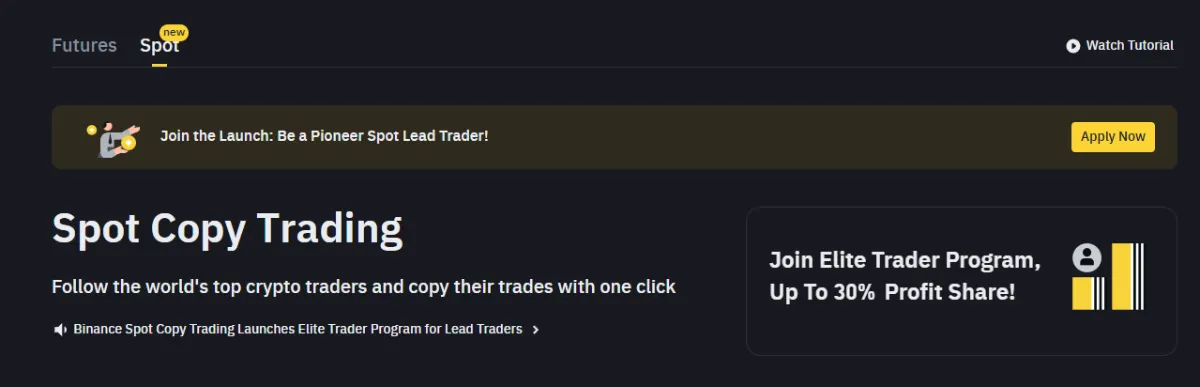
The key differences between Binance’s Spot and Futures copy trading come down to leverage, complexity, and capital requirements.
| Criteria | Spot Copy Trading | Futures Copy Trading |
|---|---|---|
| Leverage | No | Up to 125x (depending on pair) |
| Risk Level | Lower (no liquidation) | Higher (liquidation possible) |
| Fees | Spot trading fees | Futures fees (incl. funding) |
| Target Users | Beginners, DCA investors | Pro traders, high-risk users |
For risk-conscious users, Spot copy trading offers a safe, no-liquidation setup. In contrast, Futures copy trading is more suitable for those who can actively manage risk and seek higher returns.
Is Binance a Full Copy Trading Platform?
The short answer: almost.
While Binance has made big strides, especially with Smart Filters for lead traders, mock trading features, and clear ROI metrics, it still lacks a public trader ranking leaderboard and community feed, which are common on platforms like BingX or Bitget.
Still, with deep liquidity and built-in protection tools (like Copy Loss Protection Vouchers), Binance is one of the most secure and regulated options for those who prefer to copy within the Binance ecosystem.
Comparison with Dedicated Copy Platforms
Compared to dedicated copy trading platforms like BingX and Bitget, Binance offers tighter integration, trusted infrastructure, and a familiar user interface. However, some social features like live trader chat, real-time trade feed, and in-depth trader profiles are still missing.
For a broader look at how Binance stacks up:
- Check our comparison of top platforms at Best Copy Trading Platforms.
- Or explore dedicated Crypto Copy Trading platforms for more alternatives.
Start Here: Registration & Setup Guide
To start using Binance Copy Trading, you’ll need to create a verified account and configure your copy trading settings. It’s quick, safe, and easy for newcomers.
Whether you plan to be a Copy Trader or a Lead Trader, you must complete Binance’s basic KYC process, then activate copy trading features for both Spot and Futures markets.
Create a Binance Account & Verify KYC
Go to the Binance homepage, click “Register”, and choose to sign up with your email, phone, or Google account.
You’ll be required to:
- Submit personal identification (passport or national ID)
- Complete face verification
- Provide proof of residency (for some countries)
Binance typically approves KYC within 15–60 minutes.
Once verified, you can access Binance Copy Trading under the “Strategy Trading” menu.
✅ Tip: Use the same email for both copy trading and spot/futures activity to sync portfolio tracking easily.
Enable Copy Trading & API Connection

After KYC, go to Strategy Trading > Copy Trading, and follow the instructions to activate your account as:
- A Copy Trader – to follow others’ portfolios
- A Lead Trader – to publish your own strategy and attract copiers
Binance will prompt you to connect your Spot and/or Futures wallet, with separate toggles for each.
You may also be required to accept the Copy Trading Terms of Use and acknowledge risk warnings before proceeding.
Create API Key for Lead Portfolio (Spot & Futures)
If you’re becoming a Lead Trader, Binance will require you to generate an API key linked to your lead portfolio.
Steps:
- Navigate to API Management
- Create a new API and label it (e.g. “Lead Copy Portfolio”)
- Bind it to your Spot or Futures wallet
- Set IP restrictions and permissions (trading-only)
- Submit and save your API key
After setup, Binance will automatically pull trading activity from that wallet and display performance metrics (PNL, ROI, DD) on your lead profile.
⚠️ Reminder: You must maintain a minimum balance in the lead wallet (e.g. $500+) to stay listed in Smart Filter rankings.
How to Get Started on Binance Futures Copy Trading
Binance Futures Copy Trading is designed for users who want to automate trading by following the portfolios of experienced traders. You can choose to either become a Lead Trader and allow others to copy you, or join as a Copy Trader to replicate high-performing strategies with just a few clicks.
Binance offers intuitive tools such as mock copy trading, loss protection vouchers, and smart filters to discover the best traders.
Become a Lead or Copy Trader
Anyone can apply to become a:
- Lead Trader: Share your Futures strategy and earn a profit share from copiers.
- Copy Trader: Browse lead portfolios and start mirroring trades instantly.
To qualify as a Lead Trader, you must:
- Use a KYC-verified Binance account
- Maintain a minimum Futures portfolio balance (e.g. ≥ $500 USDT)
- Trade actively and consistently for >30 days
- Bind an API portfolio to the strategy page
Your performance will be tracked and displayed on Binance’s Smart Filter dashboard.
Note: Copy Traders don’t need to trade manually — your portfolio auto-executes the same positions as your chosen Lead Trader.
Use Mock Copy Trading to Test Strategies
Still unsure about investing real money? Try Mock Copy Trading to simulate results.
Mock portfolios:
- Track real market data but don’t place real orders
- Help users test different strategies and Lead Traders
- Let you experiment with Futures copy trading without any risk
This feature is great for beginners or cautious investors before going live.
Apply your Copy Loss Protection Vouchers
Binance offers loss protection vouchers to reduce risk for Copy Traders.
- These vouchers cover a percentage of losses during unfavorable trades (e.g., -10%)
- Valid only for a specific number of trades or duration
- Often distributed during promotional events or for new accounts
🛡️ Example: A voucher may cover up to 10 USDT in loss for your first 3 trades.
Swipe & Discover Lead Portfolios
Binance’s discovery interface lets users swipe through Lead Traders and explore:
- ROI over 7D / 30D / 90D
- PNL in USDT
- Max drawdown (MDD)
- Strategy tags: “Low Leverage”, “Solid Growth”, “Top Performer”
Sort traders using the following criteria:
- AUM (Assets Under Management)
- ROI tier (≥ 25%, ≥ 50%, ≥ 100%)
- Copy trader PNL
- Tags & strategy duration
📌 This visual discovery tool is unique to Binance and optimized for mobile experience.
Monitor Key Metrics of Your Portfolio
For each lead portfolio, Binance shows detailed metrics:
- 7D, 30D, 90D ROI and PNL
- Max Drawdown (MDD)
- Number of Copy Traders
- Average Copy Size
- Volatility & Win Rate
These indicators help you evaluate trader consistency and risk profile.
Compare Lead Traders in Futures
While Binance doesn’t have a traditional leaderboard, their Smart Filter system enables deep comparisons across multiple metrics.
Compare traders by the following criteria:
- ROI vs PNL vs DD
- Days active (30D, 90D, 180D)
- Copy trader profitability
- AUM ranges and minimum copy amount
🧠 Tip: Select “Top Performer” or “Whale Manager” tags if you want seasoned, high-volume traders.
Trade Failure Handling & Slippage Protection Explained
Even with a robust system, not all trades are successfully copied. Here’s why:
- Limit orders may not get filled: If the Lead Trader places a limit order that never triggers, the copied position won’t be executed.
- Slippage thresholds apply:
- BTC/ETH: max 0.3%
- Altcoins: max 0.5%
- Market volatility: If the price moves too fast, your copy may be skipped to avoid excess slippage.
Binance uses these limits to protect users from poor fills during high volatility.
Getting Started with Binance Spot Copy Trading
Binance Spot Copy Trading is ideal for beginners who want to replicate trades in the spot market without the high volatility and leverage risks of futures. While the basic structure is similar to futures copy trading, Spot offers a simpler interface and more stable experience.
Users can participate either as a Copy Trader or a Lead Trader, depending on their goals and experience.
Copy or Lead in Spot Copy Trading
You can take on two roles:
- Copy Trader: Select a portfolio and allocate funds. Binance will automatically mirror the trades executed by the Lead Trader in real time.
- Lead Trader: Share your spot trading strategy with followers and earn a percentage of their profits.
For example, if your portfolio gains +8% over 7 days, your copiers will see the same return — minus a small percentage you earn as a Lead Trader.
Understand Spot Copy Trading Rules & Limits
Before copying or leading, you should be aware of these key rules:
- Supported assets: Popular spot pairs such as BTC/USDT, ETH/USDT, SOL/USDT, etc.
- Minimum copy amount: Usually $10+
- Trade replication is proportional: If the Lead Trader opens a $100 trade and you allocate $10, your trade will be mirrored at a 1:10 ratio.
- Portfolio holding time: Some strategies may require a minimum lock-in period (e.g., 24 hours)
Binance regularly updates copy trading rules, so always review the official portfolio rules before starting.
Use Mock Copy Trading for Spot
The Mock Copy Trading feature allows you to simulate the copy trading experience without risking real funds.
- View real-time updates on portfolio metrics
- Test multiple strategies without any commitment
- Perfect for new users to explore how copy trading works
You can enable this from the “Try Demo” button on each strategy’s page.
Use Loss Protection Vouchers
Binance occasionally offers Loss Protection Vouchers for Spot Copy Trading, especially during promotional events or onboarding campaigns.
- Partially reimburses your losses within a fixed cap
- Usually valid for your first few trades or within a short time window
- Helps reduce initial risk for new copy traders
Example: A voucher may protect you from the first $5 loss across your first 3 copied trades.
Track Spot Portfolio Performance
Each Spot portfolio provides transparent statistics, including:
- 7D / 30D ROI
- Net PnL in USDT
- Max Drawdown (MDD)
- Total number of copy traders
- Assets Under Management (AUM)
Advanced filters are available to help you discover the most suitable portfolios:
- Filter by time active (e.g., ≥30D, ≥60D)
- Minimum ROI (e.g., ≥25%, ≥50%)
- Minimum AUM (e.g., $25k+)
- Tags: Top Performer, Whale Manager, Solid Growth, Low Leverage
These tools make Binance Spot Copy Trading beginner-friendly, while still powerful enough for serious investors.
Profit Sharing & Risk Management
Understanding how profits and losses are distributed in Binance Copy Trading is critical — especially for new users. Unlike traditional investments, copy trading introduces a two-party relationship where both the Lead Trader and Copy Trader are rewarded (or penalized) based on the same trade outcomes.
How Profits Are Shared Between Trader & Copier
Binance uses a profit-sharing model where profits generated by a Lead Trader are split with the Copy Trader:
- 90% of net profits go to the Copy Trader
- 10% performance fee is rewarded to the Lead Trader
- Binance charges no extra commission beyond this split
This model incentivizes top traders to manage capital responsibly and rewards them only when their strategies are profitable.
Example: If your portfolio earns $100 in net profits, you keep $90 and the trader receives $10.
Who Takes the Loss When a Trade Fails?
If a copied trade incurs a loss:
- The Copy Trader bears 100% of the loss proportional to their capital allocation.
- The Lead Trader does not share losses; their income is tied only to performance-based profit sharing.
- Binance provides no fixed loss guarantee, but some strategies may offer Loss Protection Vouchers to minimize risk in early trades.
This is why risk management settings and trader evaluation are critical before copying.
Minimum Portfolio Size & Risk Limits
Each copy portfolio has its own:
- Minimum copy amount, usually from $10 to $100 depending on the strategy
- Position size control, ensuring no overexposure per asset
- Lock-up periods, preventing premature exits in some high-frequency strategies
- Stop-copy conditions, allowing you to exit if performance drops below a set threshold
Copy Traders should always read the portfolio’s risk disclosures and parameters before allocating funds.
Advanced Risk Management for Binance Users
While Binance doesn’t yet offer custom stop loss/take profit per trade in copy mode, the following tools enhance user control:
- Mock Copying: Practice without real capital
- Copy Loss Protection Vouchers: Receive back part of early-stage losses
- Portfolio auto-unfollow settings: Exit after X days or when ROI drops below a target
- Diversification: Users can copy multiple portfolios (Spot & Futures) with varying risk levels
For deeper strategies on minimizing drawdown and controlling exposure, check out our dedicated guide on Copy Trading Risk Management
Types of Strategies & Copy Trading Preferences
Binance supports a variety of copy trading styles and strategy formats to suit different investor profiles. Whether you’re a passive user looking for steady growth or an active trader wanting to experiment with short-term volatility, there’s a suitable strategy on the platform.
Strategy Types: Grid Bot, DCA, Futures Scalp
Lead Traders on Binance can design strategies based on several trading methods:
- Grid Bot: Ideal for sideways markets, placing layered buy-sell orders across a defined range.
- DCA (Dollar-Cost Averaging): A lower-risk approach where trades are spread over time, great for volatile assets.
- Futures Scalping: High-frequency strategies that seek to profit from small price movements in futures markets.
Each strategy type includes clear performance metrics, so you can choose based on your market outlook and preferred volatility exposure.
→ AI Copy Trading Tools – Learn more about tools that automate strategy execution on Binance and other platforms.
Manual Copy vs Strategy-Based Copying
Binance doesn’t offer full manual copy trading at this time, such as choosing specific trades to replicate. Instead, copy trading is strategy-based, where you mirror an entire portfolio’s logic and execution.
- Manual Copying gives control but requires constant monitoring.
- Strategy Copying is automated and hands-off but requires strong initial selection of traders or portfolios.
For traders looking for more flexible manual-style copying, consider reading our comparison article. → Manual Copy Trading
Choosing Based on Asset Type: Crypto, Futures
Some portfolios focus on spot crypto (like BTC, ETH), while others trade leveraged futures contracts.
- Spot portfolios are generally less volatile and better for long-term holders.
- Futures strategies offer higher potential returns but come with leverage-related risks.
Choose based on your comfort with volatility and experience level.
Risk Preference: Cautious, Moderate, Bold
Binance does not label portfolios by risk level, but users can evaluate based on ROI, drawdown, and AUM:
- Conservative: Low leverage, small drawdowns, consistent returns
- Balanced: Moderate leverage, higher ROI potential, occasional volatility
- Aggressive: High leverage, large swings in PnL, suitable for experienced users
To build a strategy that matches your risk profile, read our in-depth guide: Copy Trading Risk Management
Top Trader Selection & Evaluation
Binance has recently introduced an advanced Smart Filter system for Copy Trading, allowing users to evaluate Lead Traders based on quantitative performance metrics—something previously lacking on the platform.
Filter Traders by ROI, PnL, MDD, AUM, Duration
The Smart Filter panel lets you sort and compare Lead Traders based on:
- ROI (Return on Investment): Filter by ≥0%, ≥25%, ≥50%, or ≥100% in the past 30 days
- PNL: Profit in USDT, e.g., 0 to 5,000,000+
- MDD (Max Drawdown): Filter by ≤10%, ≤30%, ≤50%, or ≤70%
- AUM (Assets Under Management): Choose portfolios managing ≥25K, 100K, 250K, or 500K USDT
- Trading Duration: Filter by ≥30D, 60D, 90D, or 180D of activity
This helps users avoid “flashy” but inconsistent traders and instead focus on consistency, resilience, and risk-adjusted performance. <!– [kw: binance smart filter] –>
Tag Examples: Top Performer, Whale Manager, Low Leverage
In addition to raw numbers, Binance adds helpful tags to highlight trader characteristics:
- Top Performer: High ROI in recent periods
- Whale Manager: Manages a large AUM portfolio
- Most Resilient: Low drawdown across volatile markets
- Low Leverage: Safer, longer-term approach
- Solid Growth: Steady gains over long durations
These visual indicators make it easier for beginners to make informed decisions, even without deep trading knowledge.
Compare with Other Platforms’ Leaderboards
Binance’s Smart Filter is a big step forward, but it still lacks full transparency and community-driven rankings seen on other platforms.
If you’re looking for clearer leaderboards and social metrics, check out:
→ BingX Top Traders
→ Bybit Top Traders
These platforms offer public leaderboards, ROI history charts, and even follower engagement data—valuable for anyone comparing trader performance across exchanges.
Performance & Profit Model
Understanding the real return potential and profit structure on Binance is critical before committing your capital. While Binance offers competitive tools, your actual ROI depends on factors like trader selection, strategy risk level, and market conditions.
Potential ROI & Drawdown Profiles
Most top-performing portfolios on Binance Futures report 30D ROI ranging from 10% to 150%, though drawdowns can reach up to 70% during high volatility.
- High-ROI strategies often come with elevated risk (e.g., Futures scalping)
- Lower drawdown portfolios typically rely on DCA or low-leverage spot strategies
To better understand ROI expectations and realistic outcomes, check out our full guide: Is Copy Trading Profitable?
Profit Sharing Model: 10% to Lead Trader, 90% to Copy Trader
Binance uses a performance-based profit-sharing model:
- Copy Traders keep 90% of net profits
- Lead Traders earn 10% from followers’ profitable trades
You don’t pay any subscription fees in advance. This aligns incentives and rewards consistent results.
Fees, Slippage, and Token Conversion After Portfolio Close
A few important notes on hidden costs:
- Trading fees still apply to each executed trade (standard Binance spot/futures rates)
- When closing a portfolio, if your copy trades were in different tokens (e.g., ETH or altcoins), Binance will auto-convert these to USDT using market rates.
- Slippage protection applies only to supported pairs and may cause missed entries.
This can affect your final return, especially during volatile hours.
Copy Loss Protection Details
Binance offers Loss Protection Vouchers to limit downside risk:
- Works with Spot and Futures trading alike
- Must be claimed in advance and applied to specific portfolios
- Value is capped and subject to terms, but it’s useful for first-time users
Combined with mock trading, this is a good safety net when testing strategies.
Investor Types: Who Is Binance Best For?
Binance Copy Trading suits the following profiles:
- DCA users looking to automate gradual entries
- Passive holders seeking better ROI than HODLing
- Low-time traders who want performance without daily monitoring
For absolute beginners, we recommend starting with a mock account and a safe portfolio.
Check out our full beginner-friendly guide here: Copy Trading Strategy Guide
Who Should or Shouldn’t Use Binance Copy Trading?
Binance’s copy trading system isn’t for everyone — but it can be highly effective when matched with the right user profile.
Who Is Binance Copy Trading Designed For?
- New traders seeking an easy and structured introduction.
Start with Spot Copy Trading and use mock trading to practice before risking real capital. - Passive investors who don’t want to analyze charts every day.
Binance’s strategy portfolios let you follow experienced traders without active management. - High-capital copy traders who can allocate ≥$1,000+ per portfolio.
Use the Smart Filter to find top performers with high AUM, low MDD, and tags like Whale Manager or Solid Growth. - Users already trading on Binance but want to experiment with low-maintenance automation.
Who Should Avoid Binance Copy Trading?
- Traders who need full customization over execution logic, risk control, or fixed parameters may feel limited. Binance doesn’t allow strategy editing.
- Users who prefer social interaction like ranking boards, real-time signals, or community voting may find Binance too “quiet”.
In that case, explore platforms with social-first design like BingX or Bitget. - Advanced traders looking to sell or monetize their strategies may find better exposure on marketplaces like MQL5 or ZuluTrade.
Binance vs BingX vs Bitget: Quick Comparison
| Feature | Binance | BingX | Bitget |
|---|---|---|---|
| Spot + Futures Copy | ✅ | ✅ | ✅ |
| Mock Trading Available | ✅ | ❌ | ❌ |
| Trader Rankings | ✅ (filters only) | ✅ (leaderboards) | ✅ (leaderboards) |
| Social Features | ❌ | ✅ | ✅ |
| Copy from Multiple Traders | ❌ | ✅ | ✅ |
| Profit Sharing Model | 10% to trader | Customizable | Fixed % |
Limitations & Warnings
Binance is a powerful exchange, but its copy trading feature comes with notable limitations that might affect specific user types. Before fully committing, here are the caveats to consider.
Lack of Transparent Trader Info
Unlike platforms such as BingX or Bitget, Binance does not offer full transparency into a trader’s complete history or detailed metrics.
- You won’t see a full trade log, entry/exit details, or trading style breakdown.
- The platform only shows ROI, drawdown, AUM, and other summaries — no in-depth statistics.
This lack of trader stats can make it difficult for serious copy traders to properly evaluate portfolios.
No Social Feed or Community Ranking
Binance doesn’t have a social layer. That means:
- No trader bio, no discussion threads, no copy trader comments.
- No public leaderboard with ranking scores or follower counts.
- No ability to follow updates, trade ideas, or real-time alerts from Lead Traders.
For users who value social copy trading, Binance may feel disconnected. <!– [kw: binance no social trading] –>
Limited Filtering for New Traders
While Binance introduced Smart Filters, they’re mostly numeric (ROI, drawdown, AUM, etc.). However:
- There’s no filtering by strategy type, trading style, risk profile, or asset preference.
- You cannot follow by keywords like “grid bot”, “ETH only”, or “low-frequency scalper”.
This makes portfolio discovery harder, especially for new users unfamiliar with how to interpret quantitative filters.
Better Social Alternatives Exist
If you’re looking for more interactive copy trading, consider platforms with richer social and transparency features.
FAQs About Binance Copy Trading
New to Binance Copy Trading? Below are answers to the most commonly asked questions to help you get started with confidence.
Yes, Binance offers both Spot Copy Trading and Futures Copy Trading. Users can choose to follow portfolios in either market depending on their risk appetite, capital, and asset preferences.
Spot Copy is more beginner-friendly with lower volatility.
Futures Copy allows higher ROI potential but comes with leverage and risk.
You can switch between the two within the Binance Copy Trading dashboard.
Yes, but only Lead Traders can integrate trading bots. If you’re a Copy Trader, you can’t directly use a bot, but you may be following portfolios that are bot-powered.
Some traders run Grid Bots, DCA strategies, or scalping bots via Binance API.
If you want to use your own bot to create a copyable portfolio, you’ll need to apply as a Lead Trader and set up API permissions accordingly.
Binance is a globally regulated exchange and offers standard security features, including:
- Verification via authentication app or SMS (2FA)
- Copy Loss Protection vouchers
- Portfolio risk management settings
However, copy trading still involves market risk, and users may experience losses depending on the trader they follow. Be sure to understand the risk/reward model before committing capital.
👉 Read more: → Copy Trading Risks
Binance doesn’t display a global leaderboard, but each portfolio shows:
- ROI over 7D / 30D / 90D
- Max Drawdown (MDD)
- PnL charts
- Copy trader performance
For more advanced comparison tools and performance metrics, check out our recommended tools:
Binance uses a performance fee model:
- Copy traders keep 90% of profits
- Lead traders receive 10% as a success fee
Fees are only charged on net profitable portfolios and are calculated automatically by Binance at the time of portfolio closure or profit realization.
A trade might fail to copy due to:
- Slippage protection thresholds exceeded
- Limit orders not executed in time
- Insufficient balance or copy allocation
- Technical issues like API disconnection
Binance has safeguards in place to prevent harmful execution, but copying isn’t always 1:1 with the lead trader.
When you close a copied portfolio:
- All open trades are closed at market price
- Your final PnL is calculated
- Profit share (10%) is deducted from gains
- Capital is returned to your Spot or Futures wallet
Make sure to account for token conversions if trading in non-USDT pairs.
Yes. Binance allows you to follow multiple portfolios simultaneously, both in Spot and Futures markets.
- Assign custom amounts to each trader
- Every portfolio operates separately
- There’s no cap on the number of portfolios you can copy (subject to account limits)
Final Thoughts: Is Binance Right for You as a Copy Trader in 2025?
Binance offers a robust and reliable ecosystem for copy trading — especially for users already in the Binance ecosystem or those who prioritize security and flexibility.
- If you’re a beginner, the Spot Copy Trading feature with mock trading is a great entry point.
- If you’re a seasoned trader, Futures Copy with smart filters and high-AUM portfolios opens the door for advanced strategies.
- However, if you’re looking for deep social interaction, fully transparent rankings, or niche strategy discovery — Binance might feel limited.
That said, Binance continues to evolve, and its blend of profit-sharing, low fees, and institution-grade security makes it a top-tier choice for many users in 2025.
🔒 Join Our Telegram Group
Want real-time updates, strategy discussions, or reviews of top-performing traders?
→ Join our Telegram channel for exclusive updates and community insights.
🔄 Open a Second Binance Account to Try New Portfolios
Already using Binance? Consider opening a second account (via a different email) to test new strategies and isolate risk per account.
This is common among advanced copy traders.
🔍 Explore Other Platforms with Transparent Leaderboards
If transparent stats and social engagement are a priority, check out our curated list of the best alternatives.
📢 Join Our Binance Copy Trading Community
Get real-time updates on top-performing Binance traders, strategy insights, and exclusive market signals — directly from our team.
🚀 Follow Binance Copy Trading Insights